Showing posts with label redemption. Show all posts

Wednesday, February 13, 2013

#BookReview: The House Girl - Tara Conklin

As a "twenty-first century white girl from New York," what does Lina Sparrow, a first year litigator at New York's most prominent law firm, know about slavery?  By her own admission, slavery and its legacy never crossed her mind.  When a reparations case lands on her desk, she wonders why she doesn't know the names of the faceless and forgotten individuals that built America, why there's no monument to them and what they wished for, worked for and loved.

Even though her law firm really does not have an appetite for taking on reparations for descendants of slaves, a wealthy client does.  To appease him, the firm brings in Lina and Garrison, an African-American second year associate, to do the research and find the perfect plaintiff.  In this case, they would prefer a plaintiff that can show indisputable evidence proof of familial ties to a slave.  And this is where it gets good.

The House Girl shifts between present-day New York and 1850s Virginia, between Lina and Josephine.  As a slave at Bell Creek, Josephine serves as the house girl for the Bells, Missus Lu in particular.  Prone to dizzy spells and forgetfulness, Lu fancies herself an artist, but Josephine is the real artist.  Raised, as it were, in the Bells' home, she has been Lu's faithful servant and confidante from an early age.  As Lu has learned how to draw, so too has Josephine.  But Josephine is a much better artist, and while Lu's works focus on scenic landscapes, Josephine draws the children and adults of the plantation, capturing their faces as no one else can.

Josephine knows no other life than that of the plantation, but she knows there's something better and longs to escape north to a better life.  In present-day New York, Lina is still searching for the perfect plaintiff when a conversation with her father leads her to an exhibit of Lu Anne Bell's work.  It's always been rumored that Lu Anne's work was actually that of her house girl, Josephine.  With help from her artist father, Oscar, and her own due diligence, Lina sets out to prove that Josephine is indeed the artist.

I was much more fascinated with Josephine's story than I was with Lina's, though I can appreciate that Lina's research brought me Josephine's story.  Equally as fascinating was Garrison's lack of desire to work on the reparation case, believing that the African American population in the U.S. is in a far better position today in comparison to those who stayed in Africa.  I also got the feeling that he believed that since he had achieved a certain level in life, there was no need to entertain the thought of reparations for those that had not been as fortunate.  In a speech from Dresser, the client who has tasked them with the case, comes a compelling argument for why reparations may be necessary.

"Let me ask you something else.  You walk down the street here, outside this building, Midtown Manhattan, center of the world in many ways.  People coming, going, important people, people with money, people with power.  Now how many black people do you see... How many black men driving cabs, selling hot dogs, hauling garbage or furniture or what have you?  how many black women getting off the night shift, or pushing a stroller with a white woman's child inside?  How many do you see? And then step inside this building, how many black men and women do you see in here?  How many are wearing suits?  How many are giving the orders?  How many are emptying the garbage?  How many are dishing out the macaroni?  Now multiply your little life by forty-one million, and is there a need for some acknowledgement that the deck is stacked?  Of course there is.  This case, the reparations idea, won't lift those men and women out of their disadvantage, but it will cause the whole rest of the world to take notice, to do some counting on their own.  An not just the Caucasians, but you too, boys like you who have achieved success in this world easier than you thought you would. Easier than your parents thought you would.  We're talking about a conversation here, not a public whipping.  It's just that money is the quickest way to get people's attention.  You call in the legacy of slavery and nobody bats an eye.  You call it six point two trillion dollars and it's a different story."

Regardless of where you stand on reparations, if you even have a stance on it, The House Girl is an interesting read and take on the topic.


336pp
Published: February 2013

Theme: Black Gold by Esperanza Spalding featuring Algebra

Monday, February 28, 2011

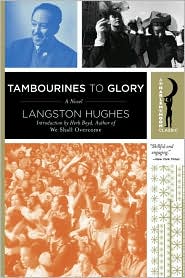
#BookReview: Tambourines to Glory - Langston Hughes

:::::whispering::::: This is my first Langston Hughes book.  I'm so ashamed to admit that.  Sure I've read his poem.  Who doesn't know Mother to Son? But before now, I've never taken the time to read any of Hughes' other work, so when I saw an audio version of Tambourines to Glory on the shelf at the library, I took it as a sign that it was time.

Set in Harlem during the Korean War, this is the story of the good-natured Essie and her good time girl neighbor Laura.  Both women are living on relief (what is now known as public aid/welfare/government assistance), but while Essie is saving her little bit of money to bring her daughter up from the south, Laura is using hers to drink and have fun.  Scheming up ways to get more money, the women decide to start their own church, right on the street corners of Harlem.

While Essie approaches the venture with a pure heart and good intentions; Laura, whose knowledge of the Bible is extremely limited, is constantly thinking of ways to increase their weekly income, including bottling tap water and selling it as holy water and using the hymnal numbers to encourage parishioners to play the numbers (lottery).  All is going well for the ladies until Laura's greed and jealousy put them both in jeopardy.

What did you like about the book?
The conversations between the Laura and Essie were priceless and very telling. Essie was more trusting of Laura than she should have been.  I think deep down she knew that Laura had no loyalty to anyone but herself, but she was determined to find the good in her to her own detriment.

What didn't you like about the book?
Really? How does one criticize Langston Hughes?

What could the author do to improve this book?
The character of Birdie Lee was hilarious. I would have loved to see more of her.


Listening time: 4 hours, 17 minutes
Published 1956, made into a musical in 1958

 
Theme: Tambourines to Glory from the musical Tambourines to Glory

Wednesday, October 6, 2010

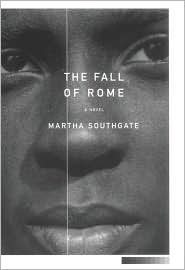
#BookReview: THE FALL OF ROME by Martha Southgate

The Fall of Rome really is a play on words.  The opening character is Jerome Washington, the only African American faculty member at a prestigious, predominantly white, all boys boarding school, The Chelsea School, in Connecticut.  Jerome firmly believes in pulling one up by one's own bootstraps without reaching back to help anyone else that might be struggling along the way.  Thanks to his hard work and his Harvard training, he's been on staff at The Chelsea teaching Latin for numerous years.  One of his greatest passions is studying Rome.

...but I share the view of those scholars who have argued that ancient Rome was a place of racial egalitarianism.  I am not so naive as to believe that this country's long history of racial prejudice has been eradicated.  But I do believe that those of us whom Du Bois called "the darker brothers" could profit from accepting the values that Chelsea at its best espouses.   And while I see this school's standards softening under the relentless onslaught of preferential treatment, I want to continue to uphold the values that the school's founders held dear.

Mr. Washington can barely disguise his contempt for Rashid Bryson, the young freshman from New York.  Rashid has come to Connecticut after the death of his brother, a death that has left his parents shells of their former selves.  Adapting to Chelsea, and its student body, will be difficult for a brown boy Brooklyn.  When he notices that the Latin class is taught by Mr. Washington, he takes the class in hopes that he'll find an ally or mentor in him.


There are so many factors at play within this story.  Rashid is looking for acceptance in a world in which he's unfamiliar.  Mr. Washington is haunted by the ghost of his past and is determined to keep boys that don't belong at a place like Chelsea out of it.  Jana needs a chance to redeem herself from her last failure to save a promising student.

What did you like about this book?
I absolutely loved this book!  Any time you find yourself talking back to the pages and wanting to punch a character in the throat, it's got to be a great book.  Martha Southgate has done an exquisite job of creating such a character in Jerome Washington.  From page one I hated him and, while I kept hoping he would have at least one redeemable quality by the end, he had none.

At one point Rashid gives a speech that sounds like something straight from the mouth of President Obama.  Given that the book was written in 2002, either the author is psychic or it's just a coincidence.  In either case, the speech he gave is just as applicable to the present day real world as it was in the fictional world in which Rashid resided.

What did you dislike about this book?
Nothing. I'm only sorry that more people haven't read it.

What could the author do to improve this book?
Not a thing.


224pp
Published January 2002


Theme: Can't Truss It by Public Enemy

Monday, July 19, 2010

#BookReview: The Sacred Place - Daniel Black

Last summer I stumbled upon a book that I really liked by Daniel Black called They Tell Me of A Home. With The Sacred Place, the author seems to have fallen into the sophomore slump.  Just as in They Tell Me of A Home, Daniel Black tackles the subject of LISWB (living in the south while black). Instead of visiting present day Mississippi, the reader is transported back to 1955.

Set during the same summer and in the same town (Money, Mississippi) where Emmett Till was murdered for whistling at a white woman, this is the fictional tale of Clement Johnson. Except it's not really fictional.  One could easily read this and come to the conclusion that the author is really telling the story of what happened to Till without directly doing so.

Like Emmett Till, Clement comes down to Mississippi to visit his family for the summer.  Accustomed to living in the big city, he pays no heed to the warnings that black people must behave differently in the south than up north.  Walking into the general store to purchase a soda is a big deal.  It's an even bigger deal when the white woman working the counter specifically asks you to place your money in her hand and instead, you place it on the counter and sass her.

It's not long before the white people in town are riled up about the new colored boy in town that doesn't know his place.  When Clement comes up missing, the black people of Money, Mississippi decide that it's finally time to take a stand.

What did you like about this book?
Daniel Black is a gifted writer.

What did you dislike about this book?
The title of the book comes from a special field that is described as the closest thing to heaven on earth.  It is here that members of Clement's family come to commune with the deceased.  It is also the place where the author loses me.  I didn't particularly care for the introduction of the supernatural aspect into what was otherwise a solid story.  In addition, there is a character that is introduced for no other reason than to show the reader that not all white people in the town are racists.  However, this character is an absolute loon and adds nothing to the story.  In fact, he's quite distracting.

What could the author do to improve this book?
My suggestion would be to either focus on the real story or the supernatural story, but not both.


298pp
Published February 2007


Theme: The Death of Emmitt Till by Bob Dylan

Monday, July 27, 2009

#BookReview: Caged Innocence - A.P. Ri'chard

Ugh, I can't stand parents that sell out their kids to save themselves. It just overcooks my grits! So you know I was boiling the whole time I read this book.

Larry Henderson is the son of the first black police officer in his small Mississippi town. Through series of flashbacks, we learn that Larry's favorite cousin was murdered by the Klan when Larry was a small boy. And before that, his father's best friend was murdered by them when they were in high school. As the men suspected of involvement in both murders start to die, the evidence begins to point at Perry Henderson, Larry's father. Larry, who has been sent to live with relatives in Las Vegas, is brought back to town by his father who turns him over to the police without hesitation. Upon questioning his father about his reasons for doing so, Larry is told that because he's only 17, the judge will be lenient on him and give him no more than four years, if he pleads guilty. Believing his father, Larry does just that and finds himself sentenced to 25 years in prison.

What kind of parent lets his son take the fall for a crime he knows he didn't commit? What kind of mother doesn't stand up for her child when she knows he's a helpless victim? This story has so many twists and turns and even when you think you have it figured out, you really don't.