When we meet 8 year old Nori Kamiza in 1948 post-WWII Kyoto, Japan, she's just been dropped off by her mother at a stately home she's never visited before. It quickly becomes apparent that Nori's mother is not returning for her daughter, the product of an affair with a Black American soldier. But Nori's young minds is unable to comprehend this and finds herself adhering to her grandmother's strict standards, under the misguided belief that if she's quiet enough and behaves well enough, her mother will come back for her.
The arrival of Akira, the brother Nori didn't know existed, opens up world and brings her the unconditional love she's craved. The introduction of Akira takes Nori on a journey that eventually leads her to Europe, but only after she's endured a nightmare she would have never dreamed she'd face.
Asha Lemmie did a wonderful job with creating her characters. It's easy to visualize Nori’s stern grandmother and powerful and mean grandfather. I have to admit that I was angry with Nori's mother so many times while reading. But Lemmie takes readers from a point of frustration to one of understanding and empathy for the character.
I gave Fifty Words five stars, but I do question the decisions the author made for adult Nori, which seemed to come from out of nowhere and were out of character for the Nori I came to know. There were also a few loose ends that weren't tied up, so perhaps a sequel is in the plans. Hopefully there's a sequel in the plans? I don't know. Have you read it? What do you think?
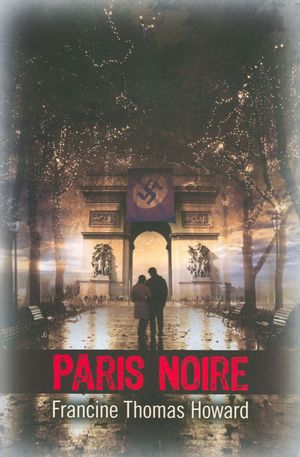
I loved the author's previous work, Page from a Tennessee Journal. I love reading about "black" Paris. And I love historical fiction. So when I came across Paris Noire, it seemed to have all of the elements of a great book. Meh, it was just ok.
Marie-Therese is the mother of two, Collette and Christophe. A native of Martinique, the mulatto Marie-Therese came to France with her children, thanks to the inheritance her father left for his illegitimate daughter and the French citizenship afforded to her by her ex-husband.
As I started Paris Noire, it seemed to me that this set up was somewhat similar to Anne Rice's The Feast of All Saints, though Feast was set in New Orleans. However, where The Feast focused on both children, much more attention was given to Christophe than to Collette.
Collette is in love with a Frenchman that her mother opposes, though we're never really told why, other than the fact that he's French. Since the author doesn't care to explain this or Collette's story line in depth, the reader is left to guess as to whether her relationship with him has any substance prior to her wedding announcement.
Christophe seems to be the real focus of the story. His affair with a married waitress turns tragic as her husband returns from war. Unfortunately, it's a tragedy that's just really uninteresting. I didn't have enough background about him to really care if he and this woman were able to be together.
One mistake that Howard made, as I see it, is that she tried to include too many players in the game. Marie-Therese has an American friend, Glovia, that hosts parties at her house. Through that connection readers are given the history of blacks in Paris with stories about Bricktop, Langston Hughes, Josephine Baker, etc. during World War II. So when Howard introduces Glovia, she introduces miscellaneous characters that attend her parties, as well as a love interest for Marie-Therese. So we're going with that story line, right? Well not really.
We jump from Marie-Therese's story to Christophe's and begin to invest time in his story line, only to be abruptly thrown back in to Marie-Therese's. Yes, I can read more than one thing at a time and follow several story lines, but this didn't flow very well. It was very disjointed and really took away from the overall story. I'd love for Howard to take another stab at this and either fully flesh out Christophe or Marie-Therese's story lines, but not both.
363pp
Published: September 2011
Theme: April in Paris by Ella Fitzgerald & Louis Armstrong
From the acclaimed author of Caucasia comes a collection of short stories exploring identity based mostly on race, but also class and gender. Told entirely from the point of view of women, the eight stories are okay, but nothing about them really stood out for me with the exception of the short, Admission.
Admission is a short about an upwardly mobile black couple that applies to an exclusive school for their pre-schooler as part of the mother's research for a film on which she's working. When their son is accepted, Cassie dreams of enrolling him, believing that it will open doors for him later in life. Her husband, Duncan, is firmly against it. Each has their own reason for wanting and/or not wanting Cody to attend.
Beyond Admission, where race truly was a factor, the remaining stories could have been based on women of any race. And maybe that was the message that Senna was trying to get across. Though the women in her book may have been separated by class, though not by much, their stories carried universal themes. We are much more alike than we are different.
What did you like about this book?
It was a very quick read. What didn't you like about this book?
Everyone I know that has read this has talked about how great it was. I thought it was just okay. It was well written, but not necessarily memorable. What could the author do to improve this book?
Remove the short story The Land of Beulah and extend Admission.
240pp
Published May 2011
Theme: Everyday People by Sly & the Family Stone