Showing posts with label Japan. Show all posts

Wednesday, November 11, 2020

Fifty Words for Rain by Asha Lemmie

When we meet 8 year old Nori Kamiza in 1948 post-WWII Kyoto, Japan, she's just been dropped off by her mother at a stately home she's never visited before. It quickly becomes apparent that Nori's mother is not returning for her daughter, the product of an affair with a Black American soldier. But Nori's young minds is unable to comprehend this and finds herself adhering to her grandmother's strict standards, under the misguided belief that if she's quiet enough and behaves well enough, her mother will come back for her. 

 The arrival of Akira, the brother Nori didn't know existed, opens up world and brings her the unconditional love she's craved. The introduction of Akira takes Nori on a journey that eventually leads her to Europe, but only after she's endured a nightmare she would have never dreamed she'd face. 

 Asha Lemmie did a wonderful job with creating her characters. It's easy to visualize Nori’s stern grandmother and powerful and mean grandfather. I have to admit that I was angry with Nori's mother so many times while reading. But Lemmie takes readers from a point of frustration to one of understanding and empathy for the character.

 I gave Fifty Words five stars, but I do question the decisions the author made for adult Nori, which seemed to come from out of nowhere and were out of character for the Nori I came to know. There were also a few loose ends that weren't tied up, so perhaps a sequel is in the plans. Hopefully there's a sequel in the plans? I don't know. Have you read it? What do you think?


Wednesday, April 26, 2017

#BookReview: PENANCE by Kanae Minato

Summary: When they were children, Sae, Maki, Akiko and Yuko were tricked into separating from their friend Emily by a mysterious stranger. Then the unthinkable occurs: Emily is found murdered hours later.

Sae, Maki, Akiko and Yuko weren't able to accurately describe the stranger's appearance to the police after the Emily's body was discovered. Asako, Emily's mother, curses the surviving girls, vowing that they will pay for her daughter's murder.

Review: Penance starts with a letter from Sae to a woman that attended her wedding, explaining how she came to know her husband and why, eventually, she had to kill him. Whoa, ma'am! I knew right then that this was going to be an interesting read.

As Minato delves into the lives of each girl, now women, that were with Emily at the time of her death, readers see that though Emily was the one that died, all of the girls were victims of the crime. And one by one, each becomes a criminal in her own way.

Because each girl has a different personality and played a different role within their group of friends, their perspectives are different. So it's interesting to watch the same story retold from their unique points of view. Quiet Sae believes that the murderer will come back to find her and leaves her small village for the big city where she can blend in and never be found. Maki becomes a teacher, determined to protect her students from the fate that befell Emily. Akiko has become an unstable homebody who continues to live with her parents and only finds joy in playing with her niece. And Yuko, who believes she has outsmarted the curse put upon the girls, finds that she really hasn't.

Minato's words brought each character to life and curiosity about the french dolls the girls referenced led me down a wormhole. While I did find the french dolls, and they were a bit creepy, I also found that Penance was made into a mini series in Japan and was shown in the U.S. in 2014. It's currently on Amazon Video, so I know what I'll be watching this weekend. I can only hope that it's as fascinating as the book.

240p.
Published: April 2017 (U.S.), 2009 (Japan)

Friday, May 13, 2016

New Books Coming Your Way, May 17, 2016

Collected Poems: 1974-2004 by Rita Dove
448 p. (Poetry; African-American)

Rita Dove’s Collected Poems 1974–2004 showcases the wide-ranging diversity that earned her a Pulitzer Prize, the position of U.S. poet laureate, a National Humanities Medal, and a National Medal of Art. Gathering thirty years and seven books, this volume compiles Dove’s fresh reflections on adolescence in The Yellow House on the Corner and her irreverent musings in Museum. She sets the moving love story of Thomas and Beulah against the backdrop of war, industrialization, and the civil right struggles. The multifaceted gems of Grace Notes, the exquisite reinvention of Greek myth in the sonnets of Mother Love, the troubling rapids of recent history in On the Bus with Rosa Parks, and the homage to America’s kaleidoscopic cultural heritage in American Smooth all celebrate Dove’s mastery of narrative context with lyrical finesse. With the “precise, singing lines” for which the Washington Post praised her, Dove “has created fresh configurations of the traditional and the experimental”

Purchase: Amazon | B & N | Book Depository | IndieBound

The Sky Over Lima by Juan Gómez Bárcena
288 p. (Fiction; South America)

José Gálvez and Carlos Rodríguez are poets. Or, at least, they’d like to be. Sons of Lima’s elite in the early twentieth century, they scribble bad verses and read the greats: Rilke, Rimbaud, and, above all others, Juan Ramón Jímenez, the Spanish Maestro. Desperate for Jímenez’s latest work, unavailable in Lima, they decide to ask him for a copy.

They’re sure Jímenez won’t send two dilettantes his book, but he might favor a beautiful woman. They write to him as the lovely, imaginary Georgina Hübner. Jímenez responds with a letter and a book. Elated, José and Carlos write back. Their correspondence continues, as the Maestro falls in love with Georgina, and the boys abandon poetry for the pages of Jímenez’s life.

Purchase: Amazon | B & N | Book Depository | IndieBound

Daughters of the Samurai: A Journey from East to West and Back by Janice P. Nimura
352 p. (Non-fiction; Japan)

In 1871, five young girls were sent by the Japanese government to the United States. Their mission: learn Western ways and return to help nurture a new generation of enlightened men to lead Japan.

Raised in traditional samurai households during the turmoil of civil war, three of these unusual ambassadors—Sutematsu Yamakawa, Shige Nagai, and Ume Tsuda—grew up as typical American schoolgirls. Upon their arrival in San Francisco they became celebrities, their travels and traditional clothing exclaimed over by newspapers across the nation. As they learned English and Western customs, their American friends grew to love them for their high spirits and intellectual brilliance.

The passionate relationships they formed reveal an intimate world of cross-cultural fascination and connection. Ten years later, they returned to Japan—a land grown foreign to them—determined to revolutionize women’s education.

Based on in-depth archival research in Japan and in the United States, including decades of letters from between the three women and their American host families, Daughters of the Samurai is beautifully, cinematically written, a fascinating lens through which to view an extraordinary historical moment.

Purchase: Amazon | B & N | Book Depository | IndieBound

Counternarratives by John Keene
320 p. (Fiction; short stories)

Ranging from the seventeenth century to the present, and crossing multiple continents, Counternarratives draws upon memoirs, newspaper accounts, detective stories, and interrogation transcripts to create new and strange perspectives on our past and present. “An Outtake” chronicles an escaped slave’s take on liberty and the American Revolution; “The Strange History of Our Lady of the Sorrows” presents a bizarre series of events that unfold in Haiti and a nineteenth-century Kentucky convent; “The Aeronauts” soars between bustling Philadelphia, still-rustic Washington, and the theater of the U. S. Civil War; “Rivers” portrays a free Jim meeting up decades later with his former raftmate Huckleberry Finn; and in “Acrobatique,” the subject of a famous Edgar Degas painting talks back.

Purchase: Amazon | B & N | Book Depository | IndieBound

The Gods of Tango by Carolina De Robertis
384 p. (Fiction; South America)

February 1913: When seventeen-year-old Leda, clutching only a suitcase and her father’s cherished violin, arrives in Buenos Aires, she is shocked to find that the husband she has traveled across an ocean to reach has been killed. Unable to return home, alone, and on the brink of destitution, she is seduced by the tango, the dance that underscores life in her new city. Leda knows, however, that she can never play in public as a woman, so she disguises herself as a young man to join a troupe of musicians. In the illicit, scandalous world of brothels and cabarets, the lines between Leda and her disguise begin to blur, and romantic longings that she has long kept suppressed are realized for the first time.

Purchase: Amazon | B & N | Book Depository | IndieBound

My Voice: A Memoir by Angie Martinez
288 p. (Biography; Latinx)

In her twenty years behind the mic at New York City’s two biggest hip-hop stations—Hot 97 and Power 105.1—Angie Martinez has become an entertainment legend. From one-time presidential hopeful Barack Obama to Jay-Z and Beyoncé to post-prison Tupac, her intimate and candid interviews with the leading names in the music business, hip-hop culture, and beyond have grabbed headlines and changed the conversation.

In the same no-holds-barred style of her radio show, Angie shares stories from behind-the-scenes of her most controversial interviews, opens up about her personal life, and reflects on her climb to become the Voice of New York.

Purchase: Amazon | B & N | Book Depository | IndieBound

Friday, January 11, 2013

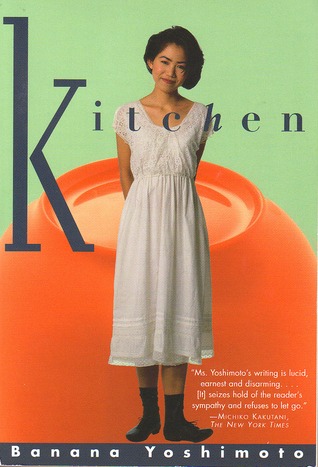
#BookReview: Kitchen - Banana Yoshimoto #BP2W (Japan)

I knew when I started this challenge that there might be some books I wouldn't get because of cultural differences.  Two weeks in and I've come across that first book.  I really wanted to like Kitchen, but it was strange and otherworldly.  It was a huge hit in Japan though, so perhaps it's just me.

Though the book has one name, it's actually two short stories.  The first, Kitchen, tells the story of Mikage.  Most people have a favorite room in their house and for Mikage, it's the kitchen.  However, it's more than just her favorite room, it's where she feels most comfortable.  So when her last living relative dies and she's offered a chance to move in with a classmate and his crossdressing father, she gladly accepts, based on the level of comfort she feels in their kitchen.

In the second short, Moonlight Shadow, young Satsuki mourns the loss of her boyfriend.  Though she's comforted by the presence of her deceased boyfriend's brother, who dresses in the school uniform of his deceased girlfriend, she longs to see Hitoshi again.  An encounter with a stranger on her morning run offers her that opportunity, but only if everything goes according to plan.

Both stories dealt with death and crossdressing men.  I don't even know what to do with that honestly.  I've not read anything else from the author, so I don't know if these are focused on in her other works.  It just seems strange that both topics would play such prominent roles within the same book.


152pp
Published: 1988
In 1603, after decades of civil warfare, the Tokugawa shogunate (a military-led, dynastic government) ushered in a long period of relative political stability and isolation from foreign influence. For more than two centuries this policy enabled Japan to enjoy a flowering of its indigenous culture. Japan opened its ports after signing the Treaty of Kanagawa with the US in 1854 and began to intensively modernize and industrialize. Following three decades of unprecedented growth, Japan's economy experienced a major slowdown starting in the 1990s, but the country remains a major economic power. In March 2011, Japan's strongest-ever earthquake, and an accompanying tsunami, devastated the northeast part of Honshu island, killing thousands and damaging several nuclear power plants. The catastrophe hobbled the country's economy and its energy infrastructure, and tested its ability to deal with humanitarian disasters. - CIA World Factboo

Location: Eastern Asia, island chain between the North Pacific Ocean and the sea of Japan, east of the Korean Peninsula 
Size: 377,915 sq km, slightly smaller than California 
Population: 127,368,088 
Ethnic groups: Japanese 98.5%, Koreans 0.5%, Chinese 0.4%, other 0.6%. Up to 230,000 Brazilians of Japanese origin migrated to Japan in the 1990s to work in industries; some have returned to Brazil (2004)
Languages: Japanese
Theme: Kimigayo