
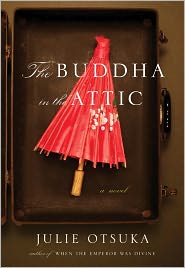
 Told in a collective voice that speaks for Japanese women that came to America, specifically San Francisco, a century ago, The Buddha in the Attic by Julie Otsuka is a compelling read. At only 144 pages, it should be a quick read, but it's not. That's not because it's a complicated read or because it's boring, but it's so good that you'll want to savor each word and each story as they come.
Broken down into eight sections, it starts with their time on the boat from Japan to America as they imagined their new lives with husbands they'd never met before, introduced only through letters and pictures. It covers their disappoint with some of those husbands who had promised them a solid, middle class life and instead could only offer them work, side by side, as a field laborer.
Not all were field laborers and so it also covers their time working as a maid in a private house or at a hotel. One line in particular stuck with me, as it made me think of the way people of color are sometimes made to feel in and out of the work place.
“One of them greeted us warmly every morning in the kitchen, but whenever she passed us outside on the street, she had no idea who we were.”
I don't work in a kitchen, but the general idea is that I have co-workers that only know me within the context of our workplace. Should I happen to pass them on the street during the lunch hour or run into them on the weekend, their eyes pass over me as if they have no idea who I am. So it was interesting to me that these women, other people of color, had this same observation.
This group of women also speaks about the shame, the sadness, the fear and the loss that came about as a result of the relocation and internment of Japanese and Japanese American citizens, particularly those on the west coast, in the United States, as a result of the bombing of Pearl Harbor during World War II. With their collective voice we hear of how homes and businesses were lost as families were forced to leave. Children were removed from schools and friends as neighbors stood by and watched, often forgetting about them shortly after their removal.
Though it is at times sad, The Buddha in the Attic is not a sad book by any stretch. For me it is simply a different look at another chapter in American history through the eyes of a group that I've not been exposed to previously.
What did you like about this book?
It really forced me to think. In reading the women's stories, it made me reflect on various immigrant's stories and their adjustments to a new life. Most fascinating was a section in which the women speak of their white employers who tell them about how they cannot trust blacks to do certain things and how the Chinese are better at this, that or the other. Consciously, or subconsciously, it becomes the basis of stereotyping of races and creates the foundation for pitting people of color against one another based on the stereotypes taught to them by those in power.
What didn't you like about this book?
At just 144 pages, it was too short. It ended just after the families were taken away to the internment camps and I would have loved to explore further and find out about their lives in the camps and after their eventual release or relocation.
What could the author do to improve this book?
As I said, I could have used a few more chapters. Otherwise, it was the perfect read.

144pp
Published August 2011



