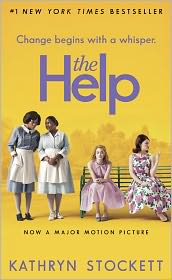
I make it a point to only speak on things about which I am knowledgeable. You won't see me jump into discussions about nuclear physics, rugby or the
Twilight books because I don't know anything about them. So it's with a little shock that I've watched several blogs discuss a book that they've admittedly never read and a movie that they admittedly will never see,
The Help. How much are some people against it? I've seen whole websites devoted to nothing but reasons why, sight unseen, they hate the book and refuse to see the movie. Of course, everyone is entitled to their own opinion, but how do you make an informed opinion about that which you've not read?
Back in 2009 when this blog was brand spanking new and no one read it except a handful of friends, I wrote a post about how much I enjoyed the book. In fact, it was my favorite read of 2009. Those people that have no desire to see the book would probably question how a movie about black servants in white households could be a favorite of any person of color. I say, easily. The characters of all of the women, not just the white women, were very well developed. Where other books by white authors have sometimes failed to humanize black servants,
The Help gave them a face and a voice.
Regular readers of this blog know that I don't care for magical Negroes such as those found in
Saving CeeCee Honeycutt and
The Secret Lives of Bees. In both books, it is black women that save struggling white children. Ironically, several people that hate
The Help without reading it have admitted to loving
The Secret Lives of Bees. Go figure. I also take exception to books with white saviors. I'm not a fan of
The Blind Side because, while it's nice that the white family takes in the poor boy of color, black women have been raising white children for over 200 years with little to no fanfare, and certainly no Sandra Bullock Academy Award. (By the way, the promotional items that are being sold on HSN as a tie-in to the movie are done in poor taste and, in my opinion, the studio has gone overboard.)
What I can say as someone that has read
The Help is that there are no white saviors and there are no magical Negroes. (Just to be sure I wasn't delusional, I spoke with a number of other readers of color who also read, and liked, the book and confirmed my thoughts on it.) Instead there are black women servants, some of whom are treated poorly by their employers. Through the words of a servant to her employer, which the employer puts down on paper, a mirror is held up for white families throughout the town. Does the mirror change the way that they treat their servants? In some instances, yes. In others, no. But it is still a teaching moment. And in my opinion, that is what a good book is. It serves as a teaching instrument.
The Help has started a dialogue, whether or not it is welcomed, amongst white readers and between white and black readers, particularly women. If we, as a country, can not dialogue about race, then we will continue to see a divide and mistrust of people of other races. NPR's Michele Norris has a section on her website called
The Race Card, which she began as a conversation starter about race. It was started in response to questions about post-racial America. You see, a lot of people felt that once Barack Obama was elected president of the United States, racism in America was dead. And, of course, nothing could be further from the truth. Michele's site proves time and time again though that more and more people want to discuss what race in America means.
Can we truly have this dialogue if we don't want to see, hear or talk about those periods in history that cause us to cringe? If Dolen Perkins-Valdez's
Wench is made into a movie, will it be more palatable because it was written by a woman of color? And what about this current generation of children that have no sense of this history? This is the same generation that didn't see why it was a big deal that the United States finally elected a black president. I think that the reason why so many white people are quick to dismiss claims of prejudice and racism by saying "Get over it" is because they are truly ignorant to how far we have not come. There are those that seem to believe that once slavery was abolished, everyone parted amiably, while ignoring the fact that there are still people walking this earth that couldn't drink out of certain water fountains or attend certain schools. Those are the people that need a mirror.
Talking to a lot of black authors on Twitter, I know that there is some resentment that a white author was able to write this book, have it received as well as it has been, and then have it turned into a movie. And let's not forget, it was her debut novel. There are authors that have toiled at their craft for years and have yet to be truly recognized by the publishing industry, let alone Hollywood. I can understand and agree with their position 100%. Black authors don't get the recognition they deserve. Other than blogging and tweeting about their books, as I do here, I don't know how to change that. I can only hope that in this post-racial America we're supposed to live in, things will get better and readers of all races will begin to see books by people of color as the norm instead of outside of the norm.
Driving around this weekend I had a conversation with my teen about the book and this post. When I told her that her 76 year old spitfire Aunt Jean had been "the help" at one point, I could have knocked her over with a feather. In my teen's world, Aunt Jean has always been the highly educated, sophisticated and well off matriarch of the family. Until I told her, she didn't realize that Aunt Jean began working straight out of high school, got married at 17 and didn't start college until she was 27. She went on to get her master's in education and retired as the principal of an elementary school. In 1952, going to college as the oldest child of 12 wasn't really an option. Working to help pay the bills was. And for someone in her position, working as the help was one of the more promising jobs. Even now in speaking to Aunt Jean, there is no shame in what she did. It was honest work for honest pay, but it was temporary. It didn't take away from who she was then and certainly not from who she is now.
So when
The Help comes out in a few weeks, Aunt Jean and I are going to see it together. And I'm dragging the teen, who in her middle class world can't fathom anyone in her family working as a maid, along. Will I love the movie as much as the book? I don't know, but I won't speak on it until I see it.
Below, Viola Davis, star of
The Help speaks on the criticism she has received for her portrayal of Aibileen.


 There comes a time in every woman's life when she realizes that her mother is human. I mean, logically, you know that your mother is human, of course. And to any other observer, it's extremely obvious. But there's a point, as a daughter, when you realize that she's just as imperfect and capable of making mistakes as anyone else. Martha Southgate's Third Girl From the Left beautifully exposes the flaws of three generations of women who are anything but perfect.